Automation starts with an understanding of the work. Before choosing a tool or introducing an AI agent, identify the process that is causing friction and the people responsible for it.
Map what actually happens
Write down the trigger, inputs, decisions, handoffs, and final destination. Include the work that happens outside the main application: email threads, spreadsheets, approvals, and manual corrections.
Talk to the people doing the task. A documented process may describe the intended workflow while leaving out the exceptions that consume the most effort.
Choose a bounded first opportunity
Look for a repeatable activity with understandable inputs and a clear definition of a successful result. Make ownership explicit. If nobody can explain what should happen when a step fails, the process needs more definition before it is automated.
Separate rules from judgement
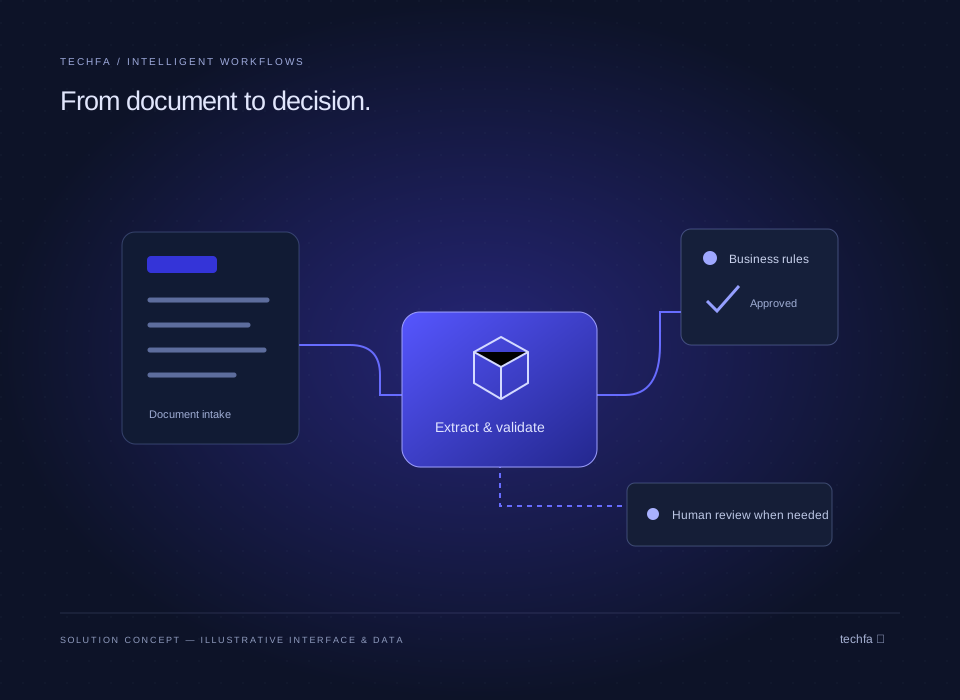
Some steps are best handled by deterministic rules. Others may benefit from classification or language models. Use AI where its flexibility serves a defined purpose, with checks appropriate to the consequences of an error.
Actions involving money, access, customer commitments, or sensitive records deserve deliberate review boundaries. The design should explain when a person approves, corrects, or stops the workflow.
Establish a baseline
Record processing time, manual effort, exception volume, and the cost of corrections. These measurements help you assess whether the change is useful rather than simply more automated.
Plan the recovery path
Consider duplicate submissions, unavailable services, partial completion, and incorrect inputs. Decide what can be retried safely and what needs investigation. Keep enough history to understand a failed run without collecting unnecessary personal data.
A useful first automation is one your team can understand, oversee, and improve. That foundation makes later expansion easier to assess.
← All insights